
Commercial Styling Chair Base Selection for Salon Projects
Quick Answer: A commercial styling chair base should be selected as part of a complete chair system, not as a decorative footprint. Buyers need to verify the seat-to-pump interface, pump and column geometry, base footprint, floor contact, swivel clearance, working height, upholstery overhang, installation spacing, cleaning routine, transport protection, and acceptance tests. Round and square bases can both work well when the complete assembled chair is stable, level, serviceable, and compatible with the salon layout. Senkelly recommends approving one documented chair–pump–base configuration before a bulk order is released.
The base is part of the styling chair system
A styling chair base carries more than the visible seat. It supports the seat frame, hydraulic pump, client load, stylist contact forces, swivel movement, and repeated changes in working height. Those forces pass through interfaces that must remain aligned during daily use, cleaning, relocation, and maintenance. A base that looks suitable in a catalog photograph can still be wrong for a project if the pump connection, footprint, floor contact, or completed-chair geometry has not been verified.
Commercial buyers often compare round and square bases first because footprint shape is easy to see. Shape matters, but it is only one part of the engineering and layout decision. Plate thickness, internal structure, column connection, contact pads, surface finish, edge condition, and the relationship between base width and seat overhang also affect the delivered result. These details should be reviewed on the actual configuration rather than inferred from a generic shape name.
Our active accessories catalog includes the P065, P01, and P03 salon chair bases as separate products for professional salon-chair applications. Their published pages confirm that they are intended as salon chair foundations, but they do not provide every project dimension or interface value. A quotation therefore needs the chair model, pump or column information, preferred base option, quantity, destination, and acceptance requirements. We should confirm the delivered combination before the buyer treats any base as interchangeable with an existing fleet.
Start with the mechanical interfaces
The most important compatibility check is the connection path from seat frame to pump and from pump to base. Bolt pattern, mounting plate geometry, column diameter, taper or sleeve arrangement, fastener access, and any anti-rotation feature must match the approved assembly. Similar-looking pumps can use different mounting details, and a base opening that appears close in size may still be unsuitable. Buyers should request a controlled drawing or supplier confirmation for the exact combination rather than approving parts by photograph.
Interface control should also identify which component determines chair orientation. A square base may have a visually preferred front direction, while a round base is rotationally symmetrical at floor level. The seat frame, pump pedal, footrest, and backrest still need a defined relationship so the assembled chair presents correctly at the workstation. A clear assembly reference prevents the pedal from ending up in an awkward position or the footrest from approaching a base edge unexpectedly.
Fasteners and retention methods need their own acceptance points. The assembly instruction should identify the correct hardware, tightening method, access sequence, and inspection evidence without inventing torque values that have not been approved. Thread engagement, washers, locking features, welds, and concealed brackets should be checked according to the delivered design. Substituting locally available hardware without an engineering review can change clearance, retention, or service access even when the new fastener fits the hole.
Compare round and square footprints by function
A round base distributes its visible footprint evenly around the hydraulic column and has no projecting corners. This can simplify rotation near a workstation and can make the visual relationship between chair and base consistent from several viewing directions. The actual diameter, edge profile, floor contact, and seat overhang still need verification. A round appearance does not by itself prove stability or guarantee that the chair will fit within the planned service zone.
A square base can provide a strong visual alignment with cabinetry, mirrors, tiles, and workstation centerlines. Its corners make orientation obvious and can help an installer position multiple chairs consistently in a row. Those same corners may extend into circulation or cleaning paths if the base is selected without a scaled layout. The buyer should compare the complete footprint and corner clearance at the chair’s real operating position rather than relying on the nominal seat width.
Neither footprint should be described as universally safer or more stable without evidence from the complete chair. Stability depends on base dimensions, mass distribution, pump location, seat height, backrest geometry, footrest, client position, floor contact, and the applicable test method. The correct procurement question is whether the approved assembled configuration passes the agreed checks. Shape can guide layout and appearance, but witnessed performance must support the final choice.
| Decision factor | Round base review | Square base review | Evidence to approve |
|---|---|---|---|
| Workstation alignment | Symmetrical footprint | Clear front and side orientation | Scaled floor plan and installed sample |
| Circulation | Check diameter and seat overhang | Check corners and diagonal envelope | Swivel-clearance trial |
| Cleaning access | Inspect full perimeter and underside | Inspect corners, edges, and underside | Approved cleaning procedure |
| Stability | Test complete chair configuration | Test complete chair configuration | Witnessed acceptance record |
Verify floor contact and level condition
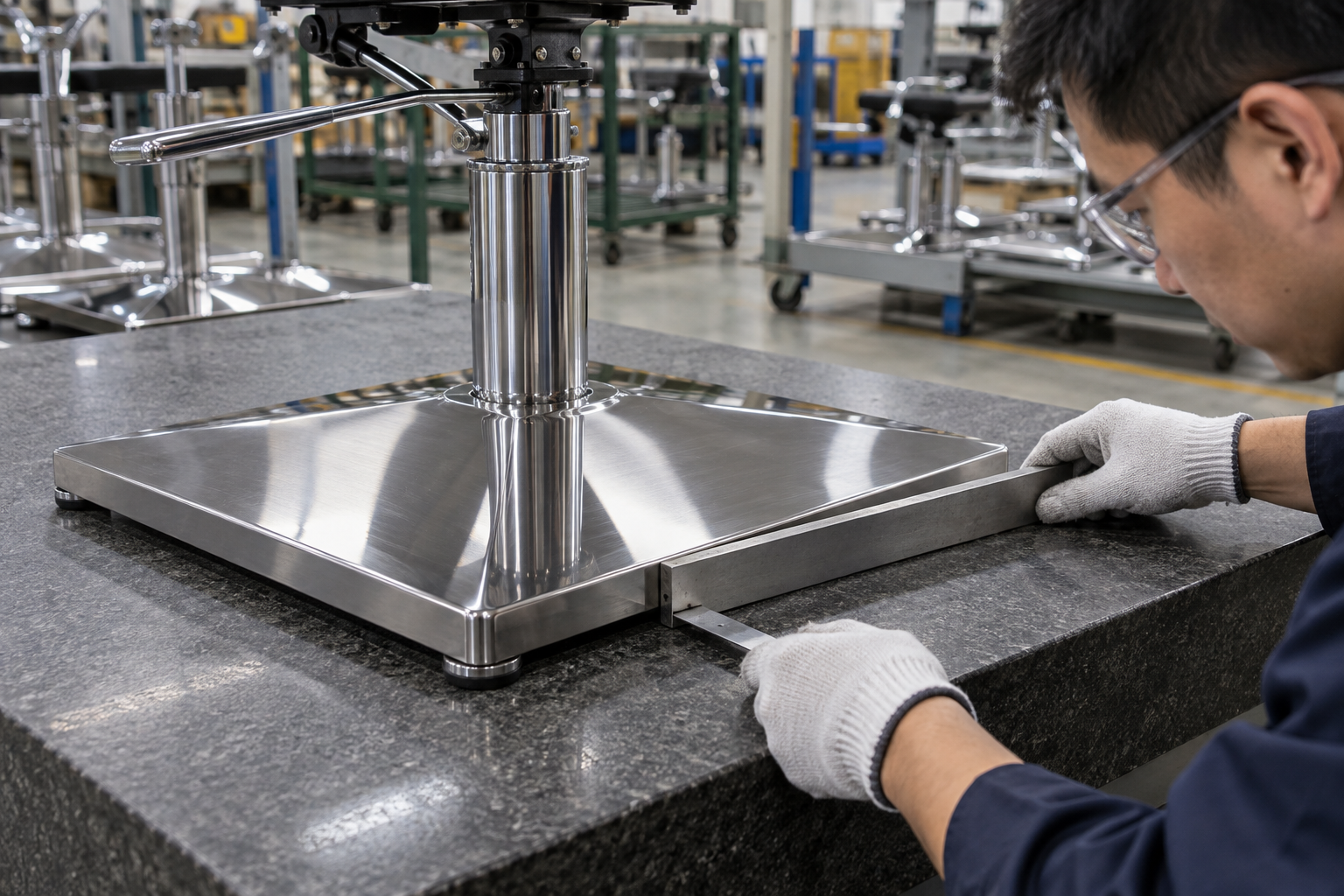
A base should sit on the intended floor without rocking, twisting, or concentrating contact at an unintended point. The factory inspection surface must be flat enough for the decision and kept clean so debris does not create a false gap. Inspectors should confirm the defined contact points and check the finished assembly rather than judging only an empty metal plate. Protective pads, feet, or edge features need to be installed in their approved production condition before the result is recorded.
Floor conditions at the salon can differ from a factory reference surface. Tile joints, local slopes, resilient flooring, raised edges, and installation tolerances can affect the perceived chair condition. The base selection should therefore include a site review and a plan for positioning chairs away from unsuitable transitions. A chair that passes on a controlled surface should not be forced to compensate for a damaged or irregular floor without an approved installation solution.
Level condition influences client comfort, pump alignment, visual appearance, and the stylist’s working position. A base or column that is visibly tilted can make the seat appear defective even if individual components are within their own dimensions. The acceptance plan should define how level, floor contact, and chair orientation will be checked together. If adjustable features are part of the approved product, their neutral setup and permitted use should be documented rather than improvised during installation.
Match the base to working height and center of load
The hydraulic pump and seat frame establish the working-height range, while the base provides the foundation under that moving assembly. Buyers should review the lowest and highest seat positions with the actual upholstery, footrest, backrest, and pump configuration. The base must remain compatible throughout the usable range rather than only when the chair is photographed at mid height. Client entry, stylist reach, and clearance under the footrest can all change as the chair moves.
Seat overhang matters because a wide upholstered chair can visually and physically extend beyond a compact base. Overhang is not automatically a defect, but it changes the movement envelope and may influence how users perceive stability. The complete chair should be viewed from the front, side, and diagonal positions and evaluated during controlled entry, exit, swivel, and height adjustment. A product card image of the base alone cannot answer these assembled-chair questions.
Loads are not always centered during salon service. Clients may place weight on one armrest, use the footrest during entry, or sit off-center while a stylist rotates the chair. Acceptance testing should represent the intended professional use and follow a documented method suitable for the product and market. Unverified load limits should not be added to an RFQ merely because a competitor publishes a number. The supplier and buyer need a configuration-specific basis for any performance claim.
Plan swivel and pedal clearance
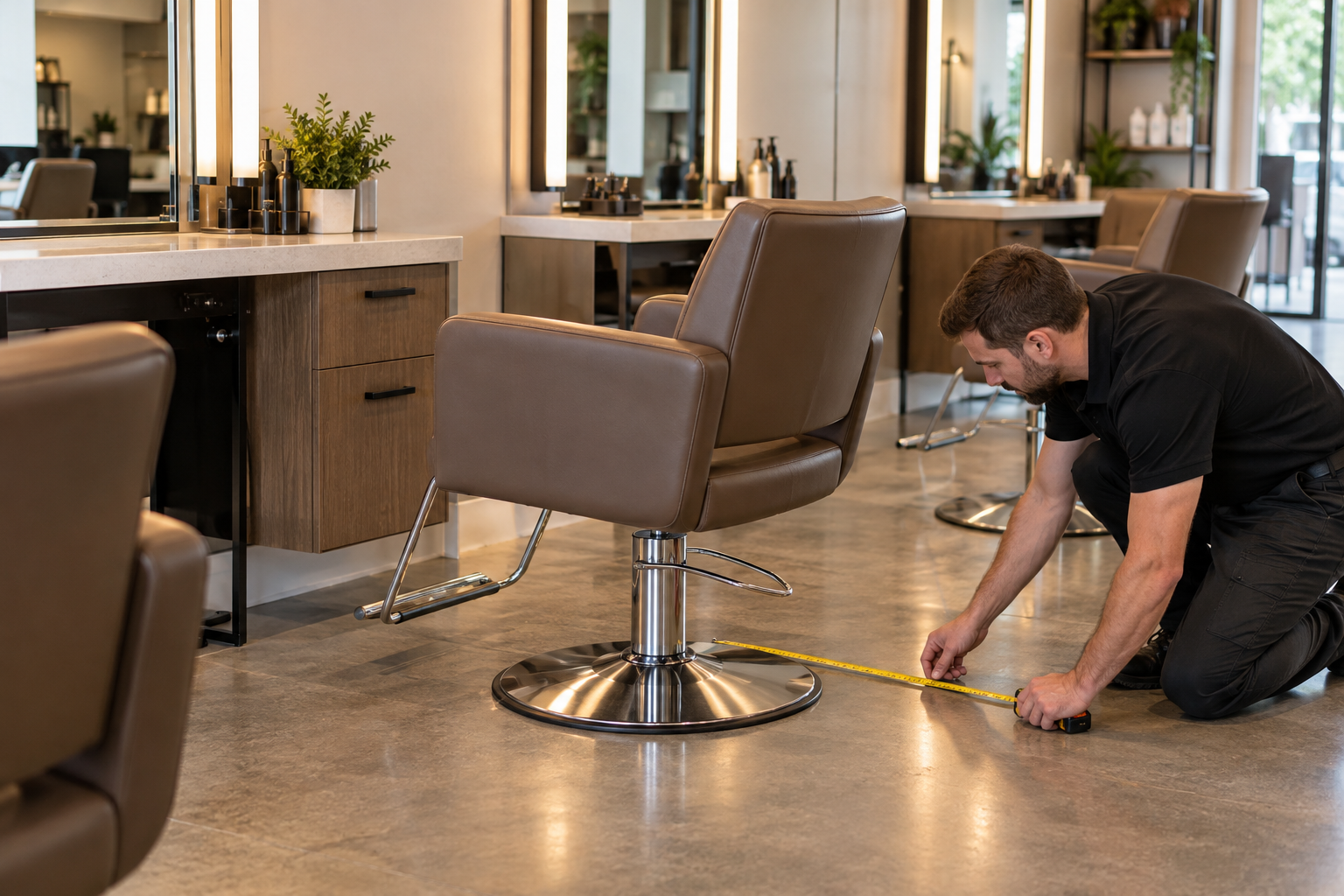
A styling chair needs enough clearance for the seat, armrests, backrest, footrest, pump pedal, stylist, and client to move without colliding with cabinetry or neighboring stations. The base footprint is only the innermost part of that envelope. A floor plan should show the chair at relevant swivel positions and include the furthest projecting component. Measurements taken from the pump centerline are more reliable than estimates based on a front-facing catalog image.
The pump pedal must remain reachable without forcing the stylist into a circulation aisle or against a cabinet. Its path should not scrape the base surface, strike the floor, or interfere with the chair frame through the approved height range. If the pump or pedal orientation changes between base options, that difference should be shown in the sample and assembly drawing. Operators should not be expected to discover the correct relationship after all chairs have been installed.
Swivel behavior also affects cable-free salon workflows even though the chair itself may use a hydraulic mechanism. A chair placed too close to a powered workstation, loose appliance cord, or storage trolley can create snagging and impact risks around the base. The layout review should consider the actual service tools and housekeeping routine. Clearance evidence is strongest when a representative workstation is assembled and observed during a realistic service sequence.
Evaluate finish, edges, and cleaning access
Polished or plated metal bases are prominent visual elements in a salon and can reveal scratches, ripples, stains, weld marks, or handling damage under bright task lighting. The buyer should define visible zones and viewing conditions with an approved sample. Inspection should distinguish acceptable process variation from defects that affect the intended appearance. Magnification or unusual lighting should not be introduced after production unless it was part of the agreed method.
Edges and corners need both appearance and handling checks. A square base should have consistent corner treatment and no harmful burrs, while a round base should have an even perimeter without local distortion. Protective films, foam, and cartons must prevent metal surfaces from rubbing against pump parts or chair hardware during transport. Removal instructions should avoid tools or methods that could mark the finish before installation.
Cleaning access should be assessed with the chair assembled. Hair, dust, liquids, and product residue can collect around the column, pedal, underside, pads, and base perimeter. The approved cleaning products and methods must be compatible with the delivered surfaces and upholstery, and claims should be supported by supplier information. A visually complex edge or recessed area may require more labor even when it performs well mechanically.
Control base and pump assembly in production
Incoming inspection should confirm that the base model, surface finish, connection geometry, protective packaging, and related pump or column components match the production order. Mixed variants should be physically separated and identified so similar-looking parts are not combined by mistake. A first-piece assembly should be completed before the batch proceeds. That unit establishes orientation, interface fit, pedal position, floor contact, swivel behavior, and visible finish expectations.
In-process checks should focus on characteristics that can drift or be mixed during assembly. Inspectors can verify hardware, seating of the column, alignment, retention, surface protection, and function at a frequency based on project risk. The exact inspection method belongs in the production control plan rather than in a marketing statement. When a check fails, the affected quantity should be segregated until the source and disposition are confirmed.
Final inspection must evaluate the chair as delivered, including upholstery, frame, pump, base, pedal, footrest, labels, accessories, and packing. A base that passes alone can still produce an unacceptable chair if the assembled centerline, swivel, height motion, or floor contact is wrong. Records should identify the chair configuration and lot so later feedback can be traced. Photographs are useful evidence when they show the actual unit and controlled inspection stage.
| Acceptance stage | Checks | Evidence | Release condition |
|---|---|---|---|
| Interface review | Chair frame, pump, column, base, hardware | Approved configuration record | No unresolved mismatch |
| First piece | Orientation, floor contact, height, swivel, pedal | Signed first-piece report | Approval before batch assembly |
| Final chair | Stability, function, finish, cleaning access | Lot inspection and defect log | Agreed criteria pass |
| Packing trial | Protection, part separation, carton orientation | Packed-sample review | No finish or interface damage |
Use verified Senkelly base options in the RFQ
The P065, P01, and P03 are active Senkelly salon chair base products and can serve as three verified starting points for a commercial styling-chair discussion. Their catalog records identify them as professional salon chair foundations intended to support stable chair use. The public records do not provide complete dimensions, mass, material construction, or pump-interface specifications. Buyers should therefore request current configuration confirmation instead of copying an unverified value into a tender.
Product selection should begin with the chair model and project layout, then narrow the suitable base and pump combination. A buyer may prefer one footprint for alignment, circulation, cleaning, or visual reasons, but each preference must be tested against the complete chair. We can review the required orientation, upholstery overhang, pedal position, and installation spacing with the project team. The final quotation should state which components and evidence are included.
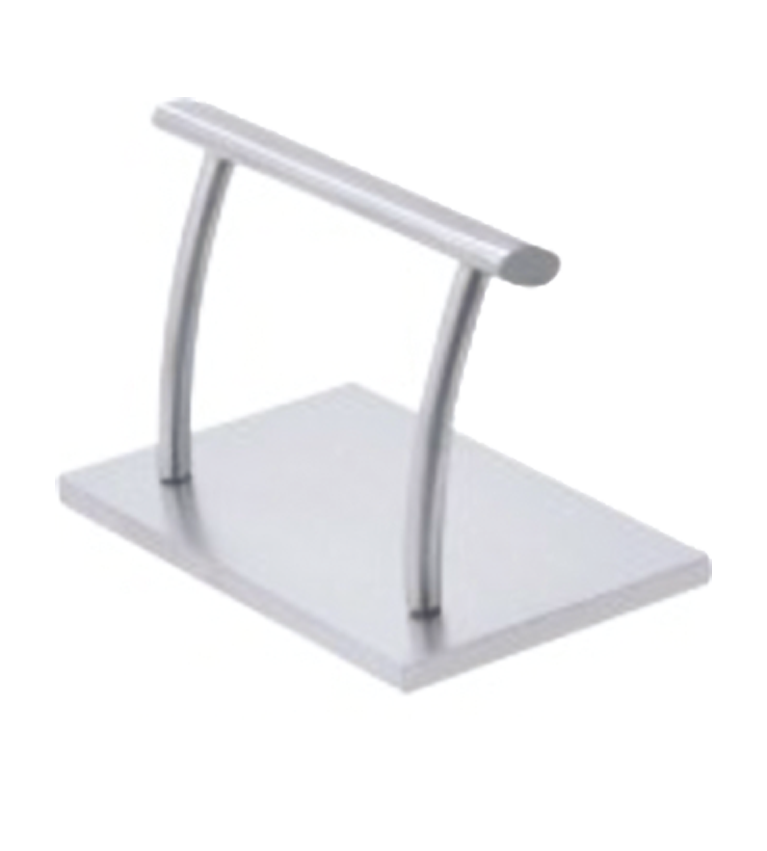
Salon Chair Base P065
An active salon-chair foundation option for configuration, footprint, interface, and acceptance review.
View Product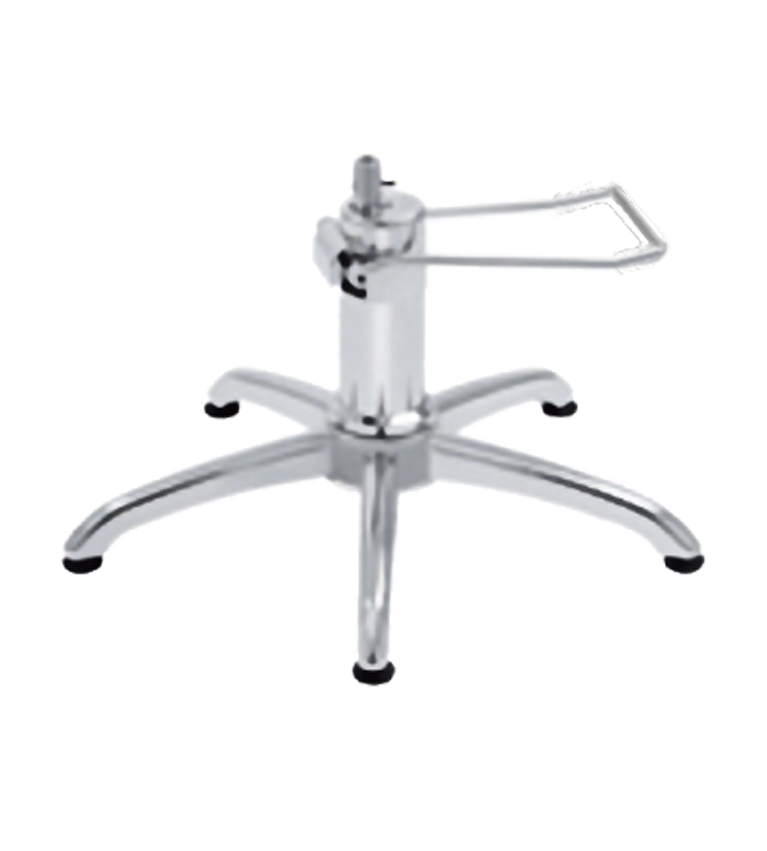
Salon Chair Base P01
A verified base option for complete-chair compatibility and commercial salon layout evaluation.
View Product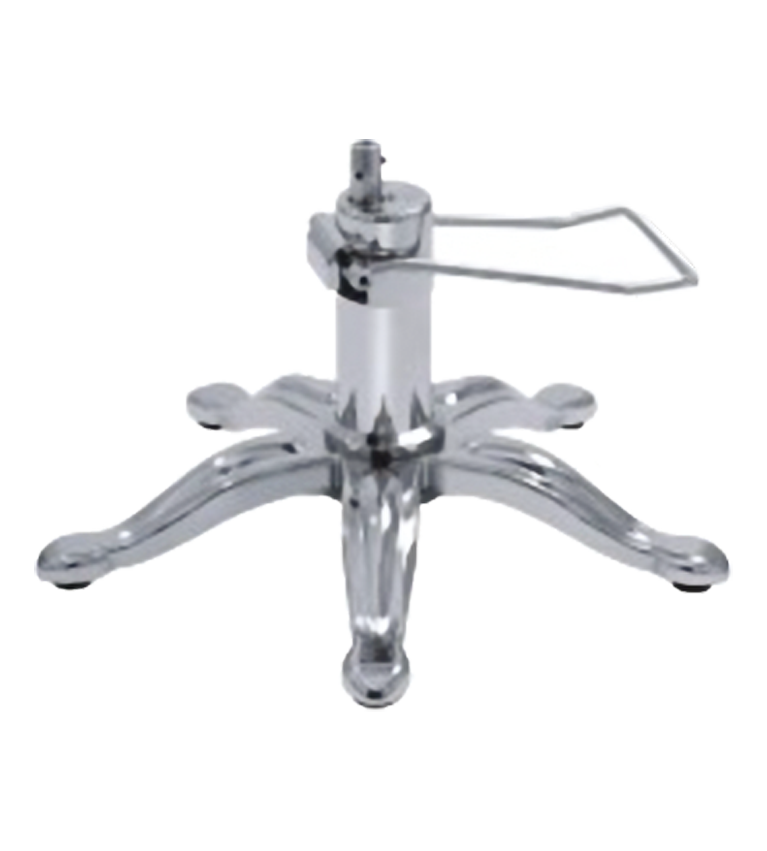
Salon Chair Base P03
A current salon-chair base listing for pump, seat, stability, finish, and packing discussions.
View ProductWrite a base-specific commercial RFQ
A useful RFQ identifies the styling chair model, seat frame connection, pump or column, footrest, upholstery width, target working height, preferred base option, quantity, salon layout, floor type, packing method, and destination. It should state whether components will arrive fully assembled, partly assembled, or as service replacements. Drawings or clear interface photographs can reduce ambiguity when an existing fleet is involved. A request for “standard base” is not enough when several compatible and incompatible standards may exist.
The buyer should also define required samples and approval stages. A pre-production sample can confirm appearance, interfaces, swivel, pedal access, floor contact, and chair height before the batch begins. A packing sample can confirm that polished surfaces and pump connections remain protected. If a buyer requires particular performance or regulatory evidence, the RFQ must identify the market and applicable requirement so the supplier can confirm what is available.
Commercial comparison should include tooling or fixture needs, assembly labor, spare parts, inspection, packaging volume, and installation support rather than unit price alone. A lower-cost base that requires an unverified adapter or creates poor workstation clearance can increase total project risk. Conversely, a visually premium option may add no functional value if it complicates cleaning or transport. The project team should compare documented lifecycle requirements and not rely on assumptions about appearance.
Plan replacement and fleet compatibility
Replacement bases need more evidence than new matched-chair orders because the original chair may have undocumented changes. The buyer should identify the current seat frame, pump model or geometry, mounting plate, pedal arrangement, connection dimensions, and condition of related parts. Photographs can help screen a request, but measurements or physical samples may still be necessary. A new base should not be used to conceal a worn pump, loose seat frame, damaged fastener, or distorted bracket.
Fleet operators benefit from configuration control. Each approved chair–pump–base combination can have a simple record with product identifiers, interface notes, photographs, spare parts, assembly instructions, and acceptance checks. Similar-looking bases should be labeled if they are not interchangeable. This prevents service teams from combining components that fit loosely, alter chair height, or place the pedal in an unintended position.
Spare planning should follow actual service risk and the supplier’s supported components. Bases are large and finish-sensitive, while pumps, pedals, fasteners, and protective pads may have different storage and replacement needs. Parts should be packed to prevent corrosion, scratching, and deformation and should remain traceable to the supported configuration. A spare that cannot be verified against the chair is inventory, not a reliable maintenance solution.
Protect the base during export packing
Polished bases can be damaged by contact with pumps, pedals, footrests, tools, fasteners, or other bases during transport. The packing design should separate hard parts, protect finished faces, control movement, and prevent the hydraulic column from loading an unsupported edge. Protective materials must be compatible with the surface and destination conditions. Tape, foam, or film that transfers adhesive can create a cosmetic claim even when the metal remains mechanically sound.
Carton orientation and pallet loading should account for the base footprint and weight distribution of the complete package. Square bases may need corner protection, while round bases need restraints that prevent rolling or shifting inside a larger carton. Accessories and hardware should be counted, bagged, identified, and kept away from finished surfaces. A packing trial should include unpacking in the planned installation sequence so hidden handling risks are found before shipment.
Pre-shipment inspection should examine packed samples as well as unpacked chairs. The inspector can confirm model labels, component quantities, surface protection, carton condition, instructions, and the relationship between package identification and production lot. If the chair is shipped partly assembled, the receiving team needs a clear method that does not require improvised leverage or contact with polished surfaces. Evidence should match the actual packaging revision released for the order.
Complete the decision with a witnessed sample
Installation teams should receive a short base-specific handover record before the salon opens. It can identify the approved chair configuration, correct orientation, permitted adjustment points, cleaning boundaries, visual inspection points, and the contact route for faults. Installers should record any floor irregularity or cabinet interference rather than altering the base or pump without approval. This keeps the delivered configuration consistent with the sample that purchasing accepted.
Early-use observations can strengthen later orders when they are recorded carefully. Useful items include unexpected rocking, movement of protective pads, pedal interference, difficult cleaning zones, finish damage patterns, fastener loosening, or repeated collisions with nearby fixtures. One isolated event should not be turned into a general performance claim, but repeated findings can identify a configuration, installation, training, or maintenance issue. The supplier needs the chair model, base, pump, location, photographs, and operating context to investigate effectively.
Maintenance responsibilities should distinguish daily operator checks from work reserved for qualified service personnel. Operators can report unusual movement, visible damage, contamination, noise, or changes in floor contact, while technicians can inspect internal connections and approved retention features. The chair should be removed from service when the responsible person cannot confirm a safe and stable condition. Releasing it after repair requires the applicable functional and floor-contact checks to be repeated.
Configuration data can also support future salon expansions. When a buyer reorders the same visual chair several years later, upholstery, pump, base, or hardware details may have changed even if the marketing name remains familiar. Referencing the original approved combination helps the supplier identify what can be repeated and what needs a new sample. A controlled reorder prevents small undocumented substitutions from accumulating across a multi-location fleet.
The selection sequence should end with a representative styling chair assembled from the proposed seat, pump, base, hardware, and footrest. The buyer or authorized inspector can check orientation, finish, floor contact, height movement, swivel clearance, pedal access, cleaning access, and compatibility with the planned workstation. Observations should be recorded against the correct drawing and product identifiers. Any accepted deviation belongs in the final configuration record before mass production.
A witnessed sample also helps distinguish a component issue from a layout issue. If the chair performs correctly on a reference surface but collides with cabinetry, the floor plan may need revision. If the base rocks on the reference surface, the assembly or component requires investigation. If the stylist cannot reach the pedal comfortably, orientation or workstation spacing may be the controlling factor. Clear evidence lets the team correct the responsible part of the system.
For a Senkelly quotation, provide the chair model, pump information, preferred P065, P01, P03, or other verified option, layout dimensions, floor condition, quantity, destination, packing mode, and acceptance requirements. We can then confirm which published products are suitable for further review and identify information that remains unresolved. The result should be one documented chair system that purchasing, production, installation, and service teams can recognize. That is more dependable than approving a base by shape or photograph alone.
Frequently Asked Questions
How should a commercial styling chair base be selected?
Select it as part of the complete seat-frame, hydraulic-pump, column, footrest and base configuration. Verify interfaces, footprint, working height, floor contact, swivel clearance, pedal position, finish, packing and acceptance tests.
Is a round base more stable than a square base?
Shape alone does not prove stability. Base dimensions, mass distribution, pump location, seat geometry, footrest, floor contact and the complete-chair test method determine the result. Both shapes need configuration-specific verification.
What information is needed for a replacement salon chair base?
Provide the chair model, seat-frame mounting details, pump or column geometry, base and pedal photographs, key connection measurements, current part condition and preferred footprint. A physical sample may be needed when records are incomplete.
How should floor contact be checked?
Inspect the fully assembled chair on a clean, suitably flat reference surface with all approved pads or feet installed. Check for unintended gaps, rocking, tilt and alignment, then review the actual salon floor separately.
What should be included in a styling chair base RFQ?
Include the chair and pump configuration, preferred base, quantity, upholstery and footrest envelope, floor type, layout, packing mode, destination, sample requirements, inspection evidence and any market-specific compliance needs.
How are polished chair bases protected during shipping?
Separate hard components, protect visible faces and edges, restrain the base from shifting, isolate loose hardware and verify the packed sample. Packing materials should not transfer adhesive or force the pump onto an unsupported edge.
- The base is part of the styling chair system
- Start with the mechanical interfaces
- Compare round and square footprints by function
- Verify floor contact and level condition
- Match the base to working height and center of load
- Plan swivel and pedal clearance
- Evaluate finish, edges, and cleaning access
- Control base and pump assembly in production
- Use verified Senkelly base options in the RFQ
- Salon Chair Base P065
- Salon Chair Base P01
- Salon Chair Base P03
- Write a base-specific commercial RFQ
- Plan replacement and fleet compatibility
- Protect the base during export packing
- Complete the decision with a witnessed sample
- Frequently Asked Questions

Styling Chair 8135

Hair Wash Station 2398

Electrical Barber Chair 8085

Hair washing bed 2378

Hair Wash Station 2392-B





Discuss Your Project with Expert Salon Furniture Manufacturers
Tell us what you need — we’ll get back to you with a fast quote and personalized OEM/ODM support.