
Salon Furniture OEM Process Explained: From Design to Delivery – A Comprehensive Guide to Professional Manufacturing
Explore the end-to-end journey of professional salon furniture manufacturing. From initial 3D design and material sourcing to rigorous quality testing and global delivery, this guide explains how a structured OEM process ensures brand quality, ergonomic excellence, and durability for salon owners and distributors worldwide.
In the competitive landscape of the beauty and wellness industry, sourcing high-quality equipment is more than just a procurement task; it is a strategic move that defines a brand's identity and service standards. For businesses looking to scale or launch custom lines, understanding the Salon Furniture OEM Process is essential. This intricate journey, spanning from the initial creative spark to the final doorstep delivery, requires technical precision, industry foresight, and a robust manufacturing partnership.
This guide provides a deep dive into the end-to-end OEM workflow, illustrating how professional manufacturers transform conceptual designs into ergonomic, durable, and aesthetically superior salon furniture.
Phase 1: Conceptualization and Design Consultation
The OEM journey begins long before the first piece of steel is cut. It starts with a vision. Whether you are looking to develop a signature styling chair or a specialized facial bed, the initial phase focuses on aligning your brand aesthetics with functional reality.
During this stage, expert engineers and designers collaborate with clients to define specifications. Key considerations include:
- Ergonomics: Ensuring the comfort of both the professional and the client.
- Material Selection: Choosing between high-grade synthetic leathers, high-density foams, and durable metal frames.
- Aesthetic Integration: Aligning colors, textures, and silhouettes with current salon interior trends.
As a leading Salon Furniture OEM Manufacturer, Senkelly emphasizes this consultative approach, leveraging years of industry data to advise clients on which designs are not only beautiful but also commercially viable and structurally sound.
Phase 2: Technical Drawing and 3D Prototyping
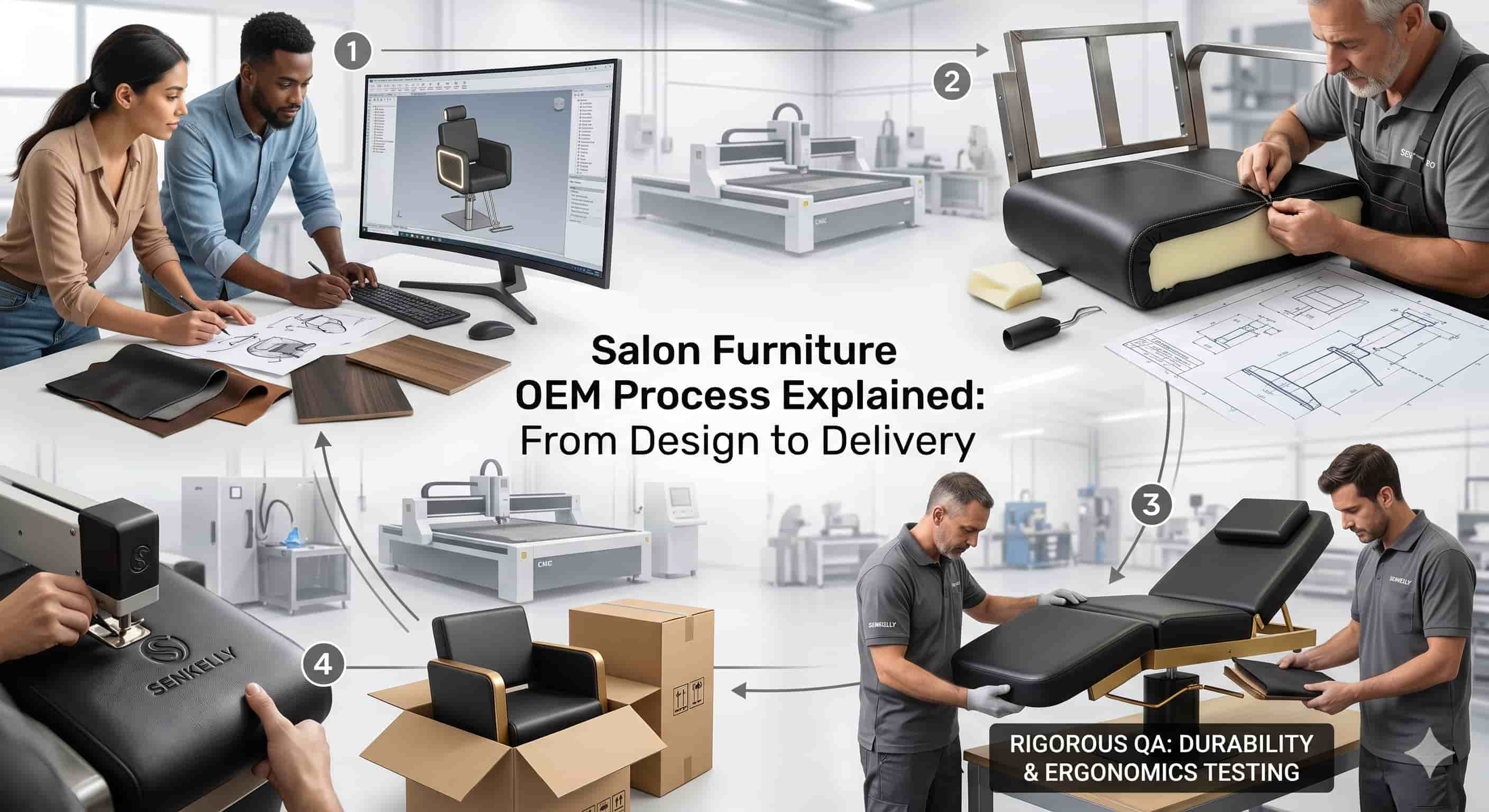
Once the concept is finalized, it moves into the technical department. Here, ideas are converted into precise CAD (Computer-Aided Design) drawings. This step is critical because it identifies potential structural weaknesses or assembly challenges before physical resources are committed.
3D rendering and prototyping allow brands to see a digital twin of their product. This "virtual prototype" covers everything from the internal hydraulic mechanisms of a salon chair to the weight-bearing capacity of a manicure station. For complex OEM projects, a physical sample is often produced. This prototype serves as the "Gold Standard" for mass production, allowing for real-world testing of upholstery tension, swivel smoothness, and overall stability.
Phase 3: Strategic Sourcing and Material Preparation
A salon's environment is demanding. Furniture must withstand constant chemical exposure (hair dyes, cleaning agents), high humidity, and repetitive physical use. Therefore, the OEM process places a heavy emphasis on material integrity.
The manufacturing team sources specialized components:
- Hydraulic Systems: The heart of any styling chair, requiring rigorous cycle testing.
- Upholstery: Medical-grade PVC or PU that offers "easy-clean" properties and fire resistance.
- Metalwork: Reinforcing bases and frames with chrome plating or powder coating to prevent corrosion.
By maintaining strict quality control over the supply chain, a professional factory ensures that the final product doesn't just look premium on day one but remains functional for years to come.
Phase 4: The Core Manufacturing Process
This is where the transformation happens. The manufacturing phase is typically divided into several specialized workshops:
Metal Fabrication and Welding
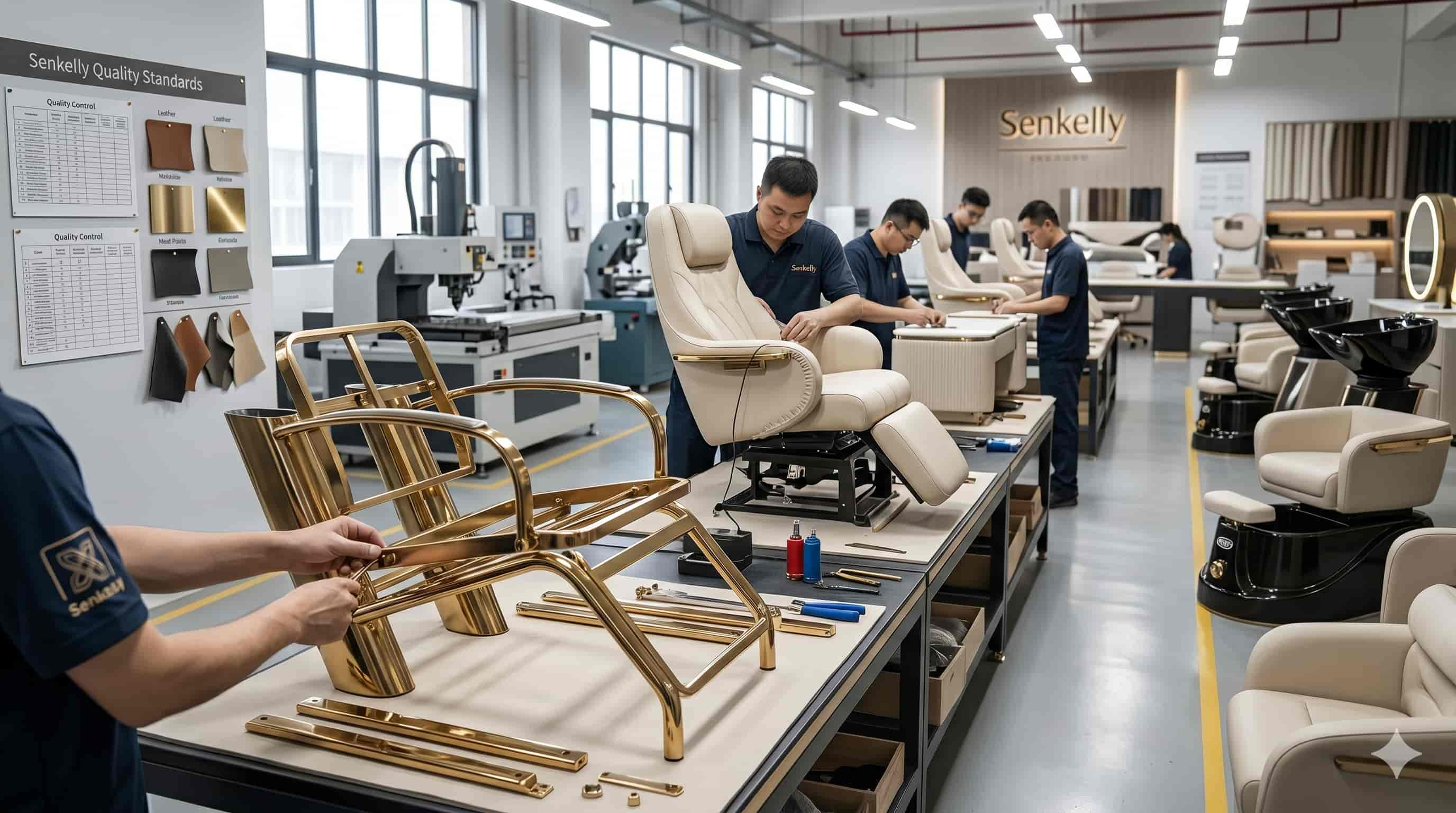
Using CNC machinery and precision welding, the skeletal structure of the furniture is created. Accuracy here is non-negotiable; even a millimeter of deviation can lead to a wobbly chair or a misaligned table.
Woodworking and Board Cutting
For salon trolleys, reception desks, and storage units, high-quality MDF or solid wood is cut and finished. Advanced edge-banding technology is often employed to ensure moisture resistance—a vital feature in hair-washing areas.
Foam Molding and Upholstery
This is a craft-heavy stage. High-density "rebound" foam is shaped to provide optimal lumbar support. Master upholsterers then hand-stitch or machine-apply the selected fabrics. The goal is a seamless finish without wrinkles or weak seams, ensuring the furniture can handle 8-10 hours of daily use.
Phase 5: Rigorous Quality Assurance (QA)
No OEM process is complete without a comprehensive testing protocol. A reputable manufacturer doesn't just check if the product "looks right"—they test if it "works right." Quality control checkpoints usually include:
- Weight Load Testing: Ensuring chairs and beds can safely support heavy capacities.
- Stability Testing: Checking for balance and preventing tipping risks.
- Chemical Resistance Tests: Swabbing fabrics with common salon chemicals to ensure no staining or cracking occurs.
- Functional Longevity: Operating hydraulics and reclining mechanisms hundreds of times to simulate years of wear.
At Senkelly, quality isn't an afterthought; it is integrated into every station of the production line, ensuring that every shipment meets international safety and durability standards.
Phase 6: Custom Branding and Packaging
The OEM advantage lies in the details. Once the units pass QA, custom branding is applied. This can involve embossed logos on the leather, laser-engraved plates on the metal bases, or custom-printed tags.
Packaging in the salon furniture industry is a science in itself. Because these items are often heavy and bulky, they require "drop-test" certified packaging. This involves reinforced corrugated boxes, custom-fitted EPE foam inserts, and moisture-proof plastic wrapping to ensure the products survive long-distance sea or air freight without a scratch.
Phase 7: Logistics, Export, and Delivery
The final stage of the Salon Furniture OEM Process is the transition from the factory floor to the client's warehouse or salon. This involves:
- Documentation: Preparing Bill of Lading, Certificates of Origin, and Customs declarations.
- Loading: Maximizing container space to reduce shipping costs for the client while ensuring items are secured against movement.
- Tracking: Providing transparency until the "design to delivery" cycle is complete.
Why the OEM Process Matters for Your Brand
Choosing an OEM path rather than buying "off-the-shelf" products offers several strategic advantages:
- Market Differentiation: You offer unique designs that competitors cannot easily replicate.
- Cost Efficiency: By dealing directly with the manufacturer, you eliminate middleman markups, allowing for better margins.
- Scalability: A structured OEM process allows you to start with a small batch and scale production as your brand grows.
Conclusion
The journey of salon furniture from a design sketch to a functional piece of professional equipment is complex and multi-faceted. It requires a synergy of creative design, engineering excellence, and disciplined manufacturing. By understanding each step—from the initial consultation and 3D prototyping to the final logistics—brand owners can make informed decisions that ensure long-term success.
When you partner with a manufacturer that masters this entire lifecycle, you aren't just buying furniture; you are investing in a seamless production engine that brings your brand's vision to life with precision and reliability. Whether you are looking for innovative salon chairs or comprehensive spa setups, a well-executed OEM process is the foundation of a premium salon experience.
- Phase 1: Conceptualization and Design Consultation
- Phase 2: Technical Drawing and 3D Prototyping
- Phase 3: Strategic Sourcing and Material Preparation
- Phase 4: The Core Manufacturing Process
- Metal Fabrication and Welding
- Woodworking and Board Cutting
- Foam Molding and Upholstery
- Phase 5: Rigorous Quality Assurance (QA)
- Phase 6: Custom Branding and Packaging
- Phase 7: Logistics, Export, and Delivery
- Why the OEM Process Matters for Your Brand
- Conclusion

Styling Chair 8135

Hair Wash Station 2398

Electrical Barber Chair 8085

Hair washing bed 2378

Hair Wash Station 2392-B





Discuss Your Project with Expert Salon Furniture Manufacturers
Tell us what you need — we’ll get back to you with a fast quote and personalized OEM/ODM support.